

Technical Writing Master Course II (TWMC2)
This course is an extension of TWMC1 and teaches advanced technical writing techniques.
-
-by Raymond Embry
- 453 Students
- Last updated
Course Description
Course Description
This course is an extension of the Technical Writing Master Course I (TWMC1). We will be teaching students about document management/control on how to manage different types of documentation in a multitude of different corporate and non-corporate environments. We will also be teaching advanced technical writing techniques on how to integrate and develop new graphic designs using a wide range of templates to achieve the creation of beautiful and presentable documentation.
We are digging deep into the System Development Life Cycle (SDLC), Document Development Life Cycle (DDLC), Language Translation Tools and Annual Reviews (and why they are important pieces to managing documentation). In this course, you will learn about more strategic and modern ways to apply existing technical writing skills with a focus on document management/control, to be used in careers pertaining to government, IT, medical, HR, service, security, application development, software engineering and more.
With this course, you also get 35 FREE Word & Excel Sheet Templates!
Please Note: If you are taking TWMC2, you do not have to take DMMC1 & DMMC2, as they are already included in lessons for TWMC2.
Course Includes
- 5.75 hours of text/video
- Practice Quizzes
- On-Demand Instructors
- Downloadable Resources
- Lifetime access to Certificate
- Access on Desktop, Mobile, and TV
- E.W. Certificate of Completion
- Access to Resume and Job Placement Tools
- 35 Free Word & Excel Templates (To use on the Job)
- Timed Final Exam (Quiz)
Learning Objectives
- Intro to Document Management for Technical Writers
- Documentation Management & Editing Tools
- Measuring Your Own Productivity (through the lens of leadership)
- Managing Different Types of Documentation
- Document Design Strategies with Templates (Advanced)
- Knowing When to Present Drafts/Final Stage Documentation
- Documentation Project Management Strategies
- Project Manager Collaboration & Scheduling
- Documentation Management Cost and Schedule Estimating
- Documentation of Translation Tools
- Documentation Annual/Quarterly Review Periods
- Documentation Archiving Strategies
- SDLC Vs DDLC

Who is the Target Audience?
This course is for the more advanced Technical Writers who may have experience in technical writing or who have already taken the beginner course (TWMC1) and want to stay in the loop on new technology and more modern ways of writing in regards to technical writing. We encourage anyone new to technical writing to start with our beginner’s course Technical Writing Master Course I (TWMC1), where you will learn everything you need to know about becoming a tech writer and about the tools necessary to begin a technical writing career.
Career Advancement
Technical writers are in the upper echelon on the salary pay scale. Beginner technical writers can make a starting pay anywhere between 55k-70k depending on their location, while experienced technical writers will make anywhere between 85k-135k based on having 6-15 years of experience.
If you work in the high-tech industry, technical writing may already be a part of your job description and daily duties. If you love to write, enjoy learning, and have an interest in technology, technical writing can be an exciting, rewarding career in itself. Job opportunities in the field are expected to grow as technology continues to advance. Take a look at the statistics on the average starting pay for technical writers below:
SALARIES FOR TECHNICAL WRITERS
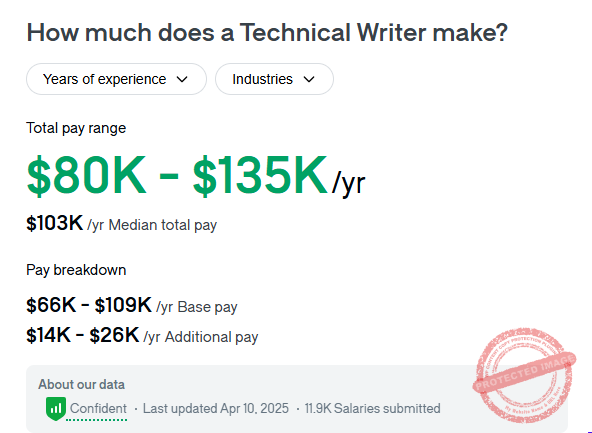
Image: Glass Door – Posted 4/10/2025
Average Salary: 80k-135k (Increases to 10-15k per added year of experience)
Average Per Hour: 40.00-75.00 Per Hour (Increases to 5-10/hr per added year of experience)
SALARIES FOR SR. TECHNICAL WRITERS
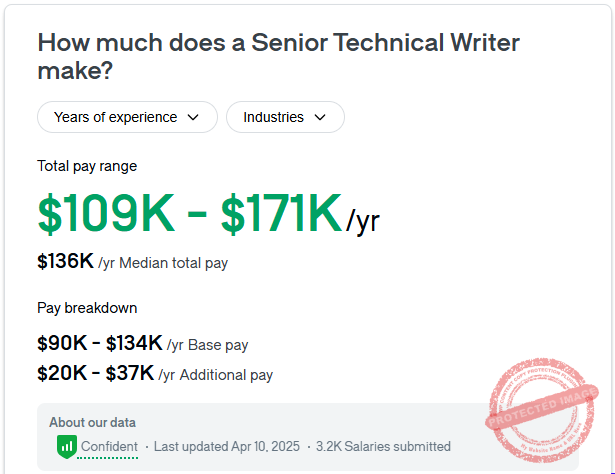
Image: Glass Door – Posted 4/10/2025
Average Salary: 109k-171k (Increases to 10-15k per added year of experience)
Average Per Hour: 55.00-90.00 Per Hour (Increases to 5-10/hr per added year of experience)
What We Do
We teach you the most important skills necessary to be a technical writer, including how to land your first job and where to go from there. When you take a class online with Embry-Williams, you can easily fit the lessons into your busy schedule. We’re your flexible learning partner, here to help you achieve your goals, your way. Throughout the course, questions are more than welcome—an inquisitive mind is an excellent trait for a technical writer to have.
Cant pay now? No Problem!
It’s smooth and simple
Select Klarna at checkout to buy now and pay later. Spread the cost of your purchase over time with convenient, stress-free payment options. It is easy and safe to use; you’re always covered by Klarna’s Buyer Protection.
The Beginning of a Great Career!
Curriculum
- 12 Sections
- 28 Lessons
- 6 Weeks
- Course Materials1 ItemPurchase of the following materials are recommended but are not required to complete this course.
- 1. Introduction to Document Management For Advanced Technical Writers4 ItemsLearn about the document management, understanding file types and how to build a document management strategy
- 2. Documentation Management Software & Document Editing Tools4 ItemsLearn about the documentation management software and highly used document editing applications
- 3.1Lesson 2a: What Modern Documentation Management Tools are Available?7 Minutes
- 3.2Lesson 2b: Using Documentation Management and Tools to Your Advantage6 Minutes
- 3.3Lesson 2c: BONUS LESSON – Most Commonly Used Document Editing Tools and Why they are Effective6 Minutes
- 3.4Lesson 2 Quiz10 Minutes5 Questions
- 3. Documentation Management Costs/Upkeep and Measuring Tech Writing Productivity3 ItemsLearn about the costs tied to documentation upkeep and how to keep clients ahead of the technology curve.
- 4. Strategies of Document Design with Templates4 ItemsLearn about different strategies that can be used to produce beautiful documents that are pleasing to both the audience and leadership.
- 5. Presenting Finalized Documentation4 ItemsLearn how to present and disseminate completed documentation to an intended audience, specifically leadership.
- 6. Documentation Project Management4 ItemsLearn about managing your documentation projects and how to keep up with tight scheduling/deadlines.
- 7. Documentation Language Translation Tools3 ItemsLearn about ways to break language barriers using the most up to date documentation language translation tools.
- 8. Documentation Review Periods4 ItemsLearn about the importance of documentation review periods and their effectiveness in the Technical Writing field.
- 9.1Lesson 8a: Understanding the Need for Documentation Review Cycles4 Minutes
- 9.2Lesson 8b: Getting Leadership to Accept and Support Implementation the Document Review Process5 Minutes
- 9.3Lesson 8c: How to Effectively Communicate the New Document Review Process to Users4 Minutes
- 9.4Lesson 8 Quiz10 Minutes5 Questions
- 9. Documentation Archiving Strategies3 ItemsLearn about the importance of document archiving and how to apply those strategies in any organization
- 10. Software Development Life Cycle (SDLC) Vs Document Development Life Cycle (DDLC)3 ItemsLearn about the SDLC and DDLC, their differences and how they are both used in Technical Writing.
- 11. Final Exam2 ItemsThis marks the end of the course and the start of your exam. Good Luck!
Your Instructors

